

Focus: Developing cryptographic algorithms and protocols critical to ensuring security and privacy and fulfilling CIA+/AAA requirements across various energy-related systems and applications.
Many protective relays possess limited processing capabilities. Consequently, standard encryption methods may prove ineffective due to their slower performance, particularly for time-sensitive protection functions. Effectively securing the distribution and management of cryptographic keys across heterogeneous devices in complex smart grid environments requires novel cryptographic techniques and innovative strategies. Research area 5 includes the following topics.
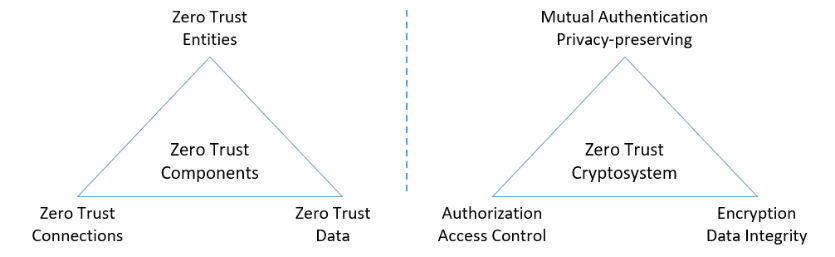
Topic 5.1 – Zero-trust Malleable Cryptosystem for Smart Grids (ZMC-SG): Developing, evaluating, improving, and implementing lightweight cryptography, e.g., on low-power microcontrollers, to enable secure communication with acceptable latency for resource-constrained energy devices such as IEDs. Designing scalable, malleable cryptographic protocols adapted to the hierarchical, latency-sensitive nature of power grid communications, under the novel zero-trust model (ZTM), i.e., zero-trust for all types of entities, connections, and data; as well as the traditional zero-trust architecture (ZTA); Never_Trust_Always_Verify.
Topic 5.2 – Quantum-Resistant Energy Systems (QuRES): Future-proofing the grid against quantum threats by evaluating and implementing NIST post-quantum cryptography (PQC) algorithms, e.g., CRYSTALS-Kyber, Dilithium, within an IEC 61850 framework. Designing "hybrid" security models that combine traditional and quantum-secure algorithms to ensure interoperability and security for the grid infrastructure. This also focuses on Quantum-Resistance Migration strategies.